
The School System Wasn’t Built For Your Child
And the research makes that uncomfortably clear

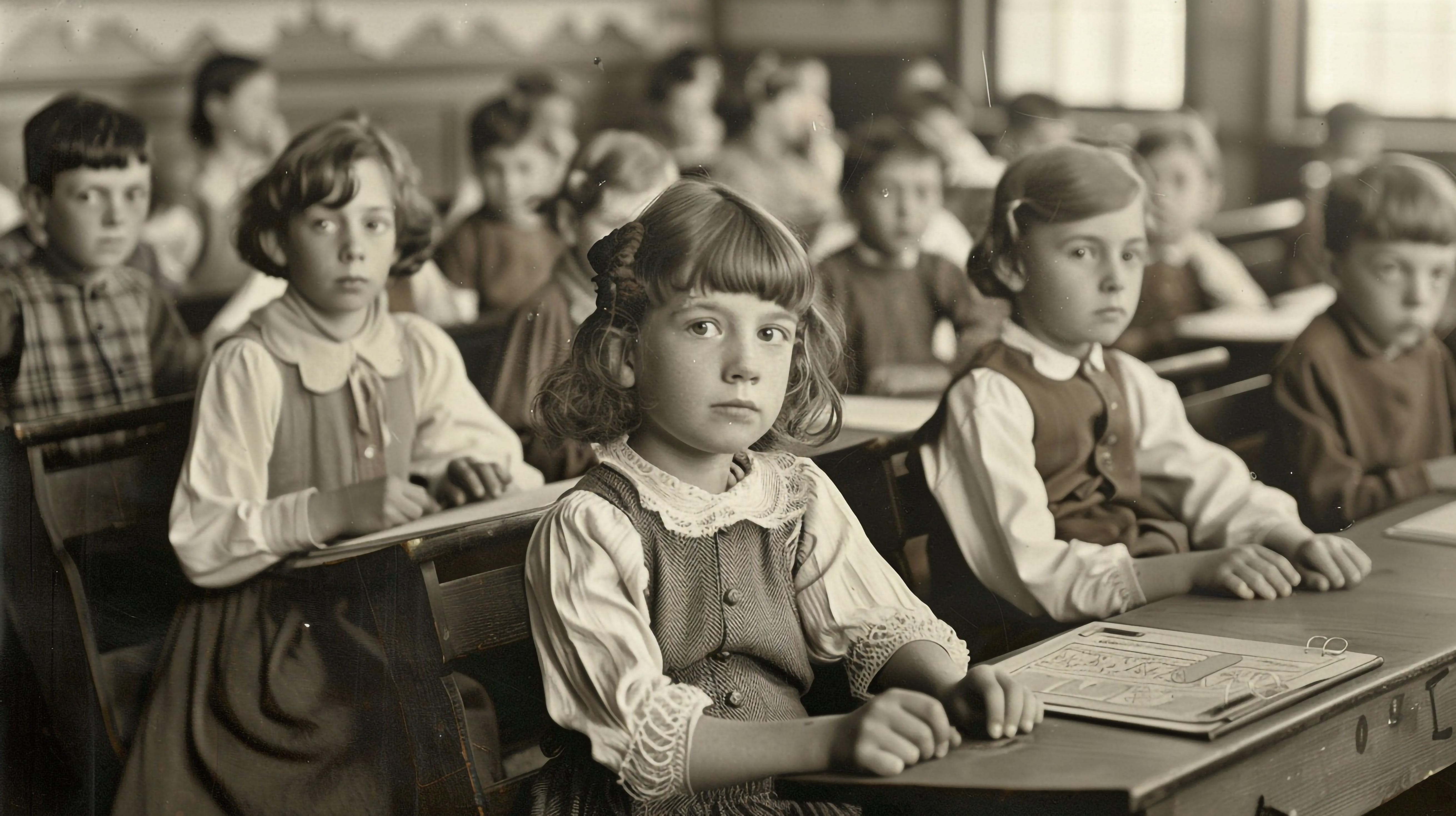
There is a question I have been sitting with for a long time, one that surfaced early in my doctoral research and never really left me.
When was school ever designed for the child?
Not for the family. Not for the economy. Not for the state, the church, or the civic ideal of a well-functioning citizen. For the child. For the actual, living, feeling, wondering human being sitting in the classroom.
The more I looked, the harder it became to find a satisfying answer.
The history we don’t teach in schools
Let’s start where most conversations about education don’t: at the beginning.
In ancient Greece, education was explicitly and unapologetically about producing citizens capable of sustaining the polis - the political community. I found Plato’s vision the most philosophically generous, he held that education should turn the soul’s own eye toward the light, drawing out what was already latent in the child rather than filling them with prescribed content. This is remarkable, and I return to it often in my work and research. But even Plato’s model was ultimately in service of the ideal society, not the individual child’s flourishing for its own sake. This is a whole new idea.
For Aristotle, who came after Plato, the child had to be trained into virtuous habits until reason could eventually take over. The child was, in this framing, a project in progress. A not-yet-adult. Something to be shaped into a particular kind of person, for a particular kind of society.
The Jesuits are famous for the quote “Give me the child until seven and I will give you the man.” Whatever you think of the sentiment, the logic is explicit: get to the child early enough and you can install the beliefs, values, and identity that will serve the institution for a lifetime. Education as formation. Formation as control.
And then industrialisation.
In the nineteenth century, Horace Mann introduced the Common School Movement in the United States with an explicit goal: to turn what he described as “uncontrollable children” into disciplined, compliant, productive citizens. School was not a gift to children. It was a social technology for managing populations. The curriculum was designed to produce workers who could follow instructions, tolerate repetition, sit still, and fit in.
We like to think we have moved past this. I am not sure we have moved as far as we imagine.
What the research actually shows about starting school
When I was reviewing the research literature for my doctoral thesis, I came across a body of evidence that genuinely stopped me. It is not widely cited in mainstream conversations about education, and I think that silence is telling.
Ray and Dorothy Moore were educational researchers who reviewed more than 8,000 studies on early childhood development. They concluded that formally enrolling children in school before the age of eight to ten was associated with a range of harms: juvenile delinquency, behavioural difficulties, emotional problems, and in some cases near-sightedness from extended close-focus work too early in visual development.
Eight thousand studies. Not a fringe finding. Not an ideological position. A synthesis of an enormous body of research.
And yet, in most Western countries, we continue to push formal schooling earlier, not later. We congratulate ourselves on the expansion of pre-kindergarten programmes. We measure school readiness in children as young as three and four years old.
What does school readiness mean, exactly?
This brings me to a study that I have never been able to forget.
The lying study
The Australian Institute of Family Studies published research, part of a longitudinal project measured children’s readiness for school. Among the markers they assessed was something they called prosocial lying: the ability to tell a socially appropriate lie.
You read that correctly.
One of the measures of whether a child was ready for school was whether they could lie convincingly in a socially acceptable way, telling someone a gift they were given was nice when it wasn’t, or that they liked something when they didn’t. Children who could manage this were assessed as more socially mature. More school ready.
I want to sit with that for a moment, because I think it deserves more than a passing mention.
We have built a system in which the capacity to suppress your authentic response, mask your genuine feeling, and perform a socially acceptable emotion on cue is understood as a developmental milestone. As readiness.
This is not a neutral finding about child development. It is a description of what the institution requires from children in order to function smoothly. And it tells us more about the values of the institution than it does about the wellbeing of the child.
A child who cannot yet lie convincingly is not developmentally behind. A child who cannot yet lie convincingly is a child who has not yet been required to fragment their inner and outer experience in order to fit in. That is not a deficit. That may actually be a sign of integration and wellbeing.
The transition nobody prepares children for
Research by Dunlop and Fabian, published in 2007, asked children about their own experience of starting school. The finding is both simple and quietly devastating, children’s first-hand accounts of beginning school often produce surprises for the adults who hear them.
The children were experiencing something the adults had consistently underestimated or not accounted for.
Separate research by Cleave and Brown found that starting school can cause anxiety severe enough to affect long-term social adjustment and translate into what they called problematic future learning. Not temporarily. Not as a passing phase. Long-term consequences from a transition that the institution treats as routine.
We send children to school. We tell them it is exciting. We buy them backpacks. And then we measure how well they perform on tasks, both academic and social, without much serious attention to what the transition actually feels like from inside the child’s experience, and what it costs them.
The child’s inner life, in this framing, is not data. It is not relevant. What is relevant is whether the child can sit still, follow the schedule, complete the worksheet, and tell the teacher their lunch was lovely when it was not.
What the dissenters have been saying for over a century
I want to be clear that there have always been voices within education that have pushed back against this. They are not new. They are not fringe. They have simply never quite managed to displace the dominant model.
Maria Montessori spent decades observing children in real environments and arrived at a conclusion that cuts against everything the standard school model assumes - children are not empty vessels to be filled with knowledge. They are beings with innate drives toward particular kinds of learning at particular times, what she called sensitive periods, and forcing them to learn what the institution has scheduled, in the way the institution has designed, in the timeline the institution has set, does not accelerate development. It disrupts it.
“Do not make children learn things,” she wrote. “Keep the light burning.” Her model said provide the environment, provide the materials, provide the attentive presence, and then trust the child’s own intelligence to direct its learning.
Rudolf Steiner’s Waldorf model was grounded in a similar conviction: the child has three distinct phases of development —body, soul, spirit — and each phase has its own way of learning, its own appropriate curriculum, its own relationship to the world. A curriculum that treats all phases the same or rushes the later phases while the earlier ones are still doing their work, is not neutral. It is harmful.
Nel Noddings, one of the most important educational philosophers of the twentieth century, was direct: education has focused too much on the head and not enough on the heart and the soul. She argued that happiness should be a legitimate goal of education, not achievement, not measurable outcomes, not employability. And she meant present-tense happiness, not the deferred happiness of a child who has done well on their exams and secured a place at a good university.
These traditions have not disappeared. There are Montessori schools, Waldorf schools, democratic free schools, and home education communities all over the world built on these principles. Many of them produce children who are curious, self-directed, resilient, and deeply engaged with their own learning.
But they remain outside the mainstream. The mainstream, the system that most children experience, is still, in its bones, Horace Mann’s machine. Still oriented toward producing a particular kind of person for a particular kind of society.
What I think this means
I am not arguing that school is without value. I am not arguing that children should not be educated in community with other children. I am not arguing that academic skills are unimportant.
What I am arguing — and what my doctoral research supports — is that the system as currently designed was not built primarily with the child’s wellbeing, inner life, or foundational needs as its organising principle. It was built with society’s needs as its organising principle. And those are not the same thing.
When we measure school readiness by the capacity to lie, we are measuring conformity, not development.
When we push formal schooling earlier in the face of research showing that it causes harm, we are serving an institutional logic, not a child’s logic.
When we are consistently surprised by what children say about their experience of starting school, we are demonstrating that the child’s perspective is not genuinely central to how we design the system.
This matters not because we need to tear everything down and start again, though a genuine reimagining would be welcome. It matters because parents, educators, and practitioners who understand this can begin to make different choices within and alongside the system that exists. They can supplement. They can advocate. They can create environments at home and in classrooms that honour what the research supports. They can pay attention to what a child is actually experiencing, not just what the institution has scheduled.
And perhaps most importantly: they can stop pathologising the child whose needs are not being met by a system that was never designed to meet them.
The child who does not fit the school is not the problem.
The school that was not designed for the child may be.
A question worth sitting with
If you are a parent, an educator, or someone who works with children, I want to leave you with a question that I have found genuinely useful:
In the environments I create for children at home, in the classroom, in any space I share with them, am I starting from the child’s needs, or am I starting from what the institution requires?
Because most of us were educated in systems that trained us to start from the institution’s requirements, we absorbed that as normal, as natural and as the way things are.
But the way things are is not the same as the way things should be. And it is certainly not the same as what the research supports.
This article draws on my doctoral research in the philosophy of childhood examining the foundational needs of children and the frameworks — educational, psychological, medical, and philosophical — that have been built to support them. The research finds that almost universally, those frameworks have been designed from an adult perspective, reflecting adult priorities, and built on an assumption of the child as deficient rather than as a complete human being with nascent capacities awaiting cultivation.
If this resonated with you, share it with a parent, an educator, or anyone who has ever felt that something about the way we treat children doesn’t quite fit.
Couldn't have said it better than this Maxine - I so value your studies, knowledge & passion in this area. Thank you for advocating for our children and putting their needs & wellbeing first. You are an incredibly wise, intuitive & heart based leader of our times. So grateful for your work & voice 🙏❤️